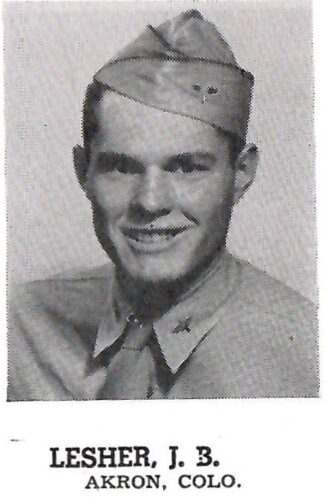
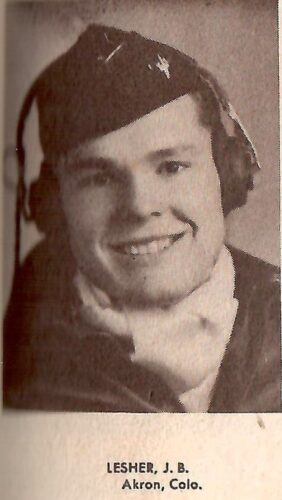
James Byron Lesher, March 11, 1924 – September 1, 1944
2Lt, Pilot, U.S. Army Air Forces
James “Jim” Lesher was born in Akron, Colorado, on March 11, 1924 to Carl R. Lesher and Valera M. (Young) Lesher. Carl was a U.S. Army pilot in WWI, flying a Nieuport 17 scout aircraft in France. He was downed behind enemy lines in 1918, and returned home after eluding capture.
Later, Carl and Valera were happy to welcome their son Jim, the first of seven siblings in the family. By 1941, Jim had become a leader at Akron High School: student body president, academic achiever, Boy Scout, and star athlete. He also found time to work for a local electric company. When the United States entered WWII in December, Jim was ready to sign up and serve his country. Young Jim wanted to serve in the expanding U.S. Army armored forces as a tank crewman, but Carl convinced his son to sign up for flight training and become a pilot.
Jim enlisted in 1942, soon after graduating from high school, and became an aviation cadet at the San Antonio Aviation Cadet Center (SAACC) in Texas. Towards the end of SAACC, cadets were classified as pilots, navigators, or bombardiers. Jim completed officer training and passed muster to begin pilot training. He was commissioned a Second Lieutenant in 1943.
During pilot training, Jim qualified in the T-6 Texan trainer at Waco Army Air Field and Moore Field, Texas, where he received his wings. Jim then began transitioning to the P-47 Thunderbolt fighter-bomber before deploying overseas. WWII raged in France following D-Day where the Allies continued liberating Europe. Jim was training hard and anxious to join the fight, but he still found time to mail care packages home. His little sisters fondly remembered receiving packages containing a fifty-cent piece for each, candy (PayDay bars and Tootsie Rolls), and cakes.
By the late summer of 1944, Jim had entered the final stages of training. The P-47 was extensively used as a ground attack aircraft in Europe, and pilots often exercised bombing and strafing targets. While conducting one of these drills, in a formation of six aircraft, witnesses saw Jim’s flight dive on a ground target at high speed, following their flight leader. The robust, but heavy, P-47 Thunderbolt was known for its ability to dive fast and sustain high g-forces while pulling up. However, Jim and another pilot were unable to gain enough altitude before striking the ground. Both pilot trainees perished.
Jim was survived by his parents, two brothers, Sam and Larry, and four sisters, Marjorie, Dorothy, Valera Lea, and Betty.
-- written by nephew Vincent E. Alonso, LTC, U.S. Army (Ret.), on behalf of Lea (Lesher) Holtorf, Jim’s sister, July 13, 2024